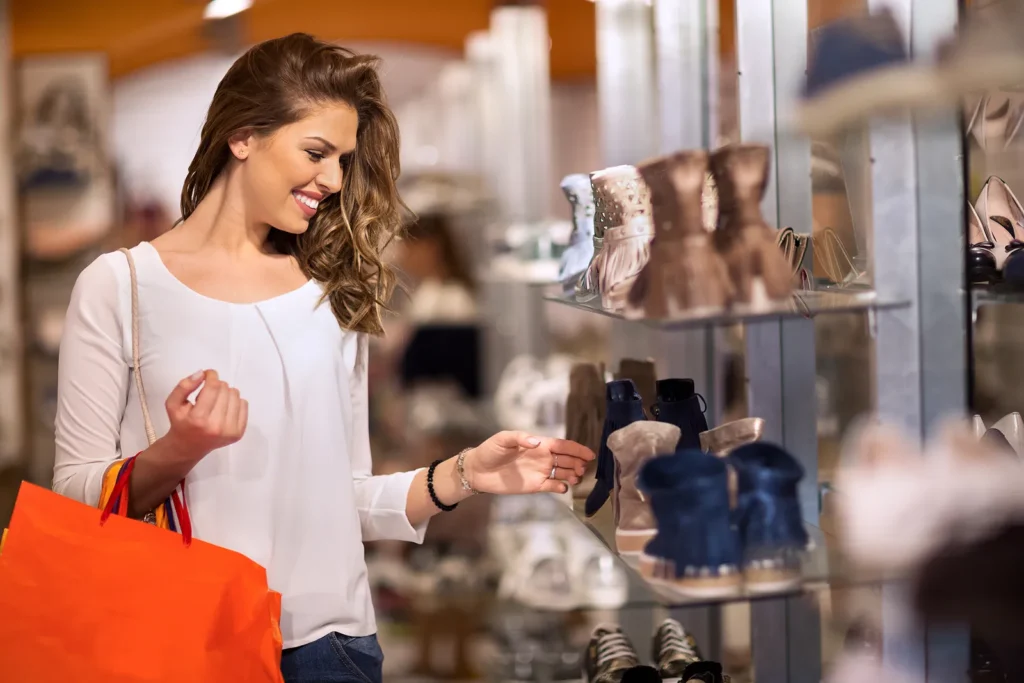
Lifestyle

Why real-world shopping is back.

Why real-world shopping is back.

There’s something exhilarating about shopping online. The convenience of browsing dozens of stores from the comfort of your couch, the anticipation of delivery and the small thrill of finding a package waiting on your doorstep. When it all goes to plan, it’s easy to wonder why anyone would bother heading into a store at all.

But it’s the delayed shipping, the dress that looks nothing like the photos, the impossible returns process or the dreaded “final sale” policy that quickly reminds us of the downside of convenience. And suddenly, the appeal of wandering through the shops with a coffee in hand starts to feel enticing again.

After more than a decade of rapid digitalisation, face-to-face shopping is making a comeback. Australians are increasingly craving real experiences, personalised service and human interaction over endless scrolling and checkout carts.

Nearly three in four Australians say they’ve changed their shopping behaviour in the past 12 months, with 61 per cent now preferring to buy non-essential items in store. While online shopping remains a major part of modern consumer life — particularly for younger generations — many shoppers are being drawn back to physical retail by the experience itself.

And there are some things online shopping simply can’t replicate.

There’s the instant gratification of walking out with your purchase that day. The ability to try something on properly, feel the fabric, compare colours in real lighting or ask someone for advice. In an era of rising living costs and increasingly enhanced online imagery, shoppers are becoming more cautious about where they spend their money. Seeing a product in person offers reassurance that no size chart or customer review can quite match.

Post-COVID, shopping centres briefly became places many people avoided altogether. Now, foot traffic is steadily returning, helped along by the redesign of retail spaces into lifestyle destinations that offer much more than shopping alone.

Many centres now incorporate wellness spaces, dining precincts, entertainment and flexible work areas, creating environments designed for people to spend time in rather than simply buy and leave. A quick trip to the shops has once again become lunch with friends, an outing with the kids or a slow Sunday morning wandering through stores after coffee.

But it’s not just major shopping centres benefiting from the shift.

As people increasingly seek connection and community, many are turning back toward small businesses and local retailers. Supporting independent stores, discovering locally made products and chatting with someone behind the counter offers a level of authenticity and trust that can feel difficult to find online.

The personalised service these businesses provide often transforms a simple purchase into something far more meaningful. Customers feel recognised and valued rather than treated like another transaction, and in a world where so much of life now happens through screens, that human interaction matters.

Of course, online shopping isn’t disappearing any time soon. Instead, retail is evolving into a hybrid experience where customers move seamlessly between digital convenience and in-store connection.

Click-and-collect services, dedicated pickup zones and weekend pop-up stores have become standard, while many online-first brands are increasingly appearing at local markets and temporary retail spaces. Studies show around 80 per cent of shoppers now actively use a combination of both online and in-store shopping, often researching products online before heading into stores to make the final purchase.

The future of retail no longer appears to be a choice between digital and physical shopping. Increasingly, Australians want both.

Because while convenience may have changed the way we shop, it turns out people still value the experience of shopping itself.


More from

Lifestyle

Print is back baby!
Lifestyle

Print is back baby!

By Leanne Hart, Publisher, Get It Magazine I bought a newspaper the other day. The first one I’ve bought in years. Real paper, no scrolling, no pop-ups—just me, coffee, and quiet. And sitting there, I started thinking about why print advertising in Australia is having a moment that a lot of marketers are quietly scrambling to catch up with. One detail stopped me cold: Harvey Norman owned nearly a quarter of the 94 pages through advertising alone. My first thought wasn’t how much did that cost? It was why? Here’s a massive company with budgets that could buy every digital channel available. Yet they still invest heavily in print. That question wouldn’t leave me alone. The answer, I realised, points to something bigger than nostalgia. It’s about what actually works when everything else is screaming for attention. The Digital Noise Problem Let’s be honest about where we are. Your phone pings constantly. Feeds refresh faster than you can read them. Algorithms shuffle content before you finish a sentence. Someone’s always trying to sell you something, and it all blurs together—real posts mixing with ads mixing with AI-generated answers that appear before you even click through. This isn’t digital fatigue in the romantic sense. It’s structural exhaustion. The medium itself has become unreliable. Google now serves AI summaries in roughly one in five searches, cutting traditional click-through rates from 27% down to 11% for top positions. Some research shows drops of nearly 50%. Businesses can’t rely on a single traffic lane any more. The old assumptions don’t hold. But here’s what’s interesting: while digital channels erode, something else is quietly happening. People aren’t abandoning the internet. They’re actively choosing something different when they want to actually pay attention. Why Print Works Differently There’s something fundamentally different about sitting down with a magazine or newspaper. It’s slower. More intentional. Less “blink and you’ve missed it.” When you hold a publication, you’re not competing with a hundred other posts appearing two seconds later. The advertiser isn’t fighting an algorithm. They’re meeting you in a space where you’ve already decided to slow down. And credibility matters here in ways digital struggles to replicate. Appearing in a trusted publication carries weight. Readers instinctively know that businesses in print have invested real money and commitment to reach their actual audience—not just anyone who scrolls past. Print signals intentionality. There’s also the sensory element people underestimate. You can return to a magazine later. Leave it on a coffee table. Hand it to someone. The physicality changes how you engage with it. It feels considered. Real. Not disposable. The Real Opportunity This isn’t about choosing print or digital. It’s about recognising that balance is where things actually get interesting. Harvey Norman understands something important: as digital becomes noisier and less reliable, people are actively seeking spaces where they can stop and genuinely engage. They’re hungry for credibility. For undivided attention. For something that feels intentional rather than algorithmic. The businesses paying attention to this shift aren’t nostalgic. They’re strategic. They see that stepping outside the usual digital box—finding the quiet spaces where people actually pay attention—still works. Sometimes the oldest solutions still deliver what newer channels promise but can’t quite achieve: genuine connection with people who are ready to listen. That’s not print coming back. That’s print finally making sense again.“Print Never Left. We Just Forgot Why It Mattered.“

Girls are out-earning boys, and here’s how parents can help them stay ahead.
Lifestyle

Girls are out-earning boys, and here’s how parents can help them stay ahead.

By Molly Benjamin, Founder of Ladies Finance Club    When it comes to finances, new research has found that girls across Australia are earning more pocket money than boys, and they’re saving it faster, too. In a cost-of-living crisis, it’s encouraging to see, as it shows that the next generation is writing their own story around money.   Yet, what can be all too common is that somewhere along the way, money confidence starts to fade in girls. By adulthood, women are less likely to negotiate, invest, or take financial risks. It’s a pattern we see in the gender pay gap, as well as in superannuation savings. Women fall behind financially.  As a financial educator, I see this all the time. Boys are encouraged to take risks, try, fail and learn. Girls are praised for being neat, disciplined and sensible. We talk to boys about growing wealth and talk to girls about becoming good savers. Over time, that difference can shape how we negotiate, invest, or even talk about money.  Recent findings from the Spriggy Economy Report, which analysed the habits of more than 790,000 Australian kids, shed light on this early money story. It found that girls are actually out-earning boys ($1.03 vs $1.00), which is the reverse of the adult gender pay gap, where women earn just $0.88 to the dollar. Australian kids collectively earned $286.3 million this year, with pocket money growing 11 per cent faster than wages. But while girls are thriving financially in childhood, social conditioning soon teaches them to be cautious rather than bold, to save carefully rather than build confidently.  The key to changing this lies in simple, practical money lessons at home. Ones that build independence, confidence, and choice-making skills early. Parents can help stop that slide by focusing less on outcomes (“Did you save it?”) and more on confidence (“How did you decide that?”). It’s about giving kids, and especially girls, permission to make choices, mistakes and plans with money.  One simple way to build this foundation is the three piggy bank method, something I’ve used for years to help kids visualise how money works:  Piggy bank 1: Spend: the ‘freedom’ jar. This teaches kids choice, value and the joy of earning something yourself.  Piggy bank 2: Save: this builds patience, planning and the reward of delayed gratification.  Piggy bank 3: Give: this fosters generosity and empathy, connecting money to meaning.  You don’t need fancy tools to try this at home. A few piggy banks, jars or envelopes work perfectly. What matters most are the conversations that you have with your kids around them: Why save? What feels worth spending on? Who or what do we care enough to give to?  Teaching kids how to use money, not fear it, is one of the most valuable gifts we can give. Because when children grow up knowing they can make choices, plan ahead, and trust their judgement, they carry that confidence for life. Girls may have the financial lead right now, but it’s up to us to make sure they keep it, not just in childhood, but well into adulthood.

Stop hating dating
Lifestyle

Stop hating dating

Why dating can feel like a performance (and how to start enjoying dating again)  Somewhere between “just be yourself” and “don’t be too much,” dating turned into an unpaid acting gig. I know the role well. I’ve played it. I’ve been the version of me that seemed the most dateable, attractive and polite, all while pretending not to care. I thought if I could get it right, then someone would finally choose me. I was exhausted. When I struggled to find a partner who understood me, I thought there was something wrong with me, but I was just disconnected from who I really was.  Why we start performing  This isn’t just a matter of fitting in or being enough. When our need for belonging feels uncertain, we start shapeshifting. From childhood, we learn that being liked keeps us safe. By age two, we’re already forming a sense of self. When that self is met with criticism or inconsistency, we adjust to keep the connection alive. We start measuring our worth by how comfortable other people feel around us. And the more we do that, the further we drift from ourselves. Science backs this up: when we spend too much time focused on how others see us, it increases anxiety and dulls our ability to connect with our own emotions. Understandably, dating starts to feel like a performance we have to get right. We’re craving a sense of safety and belonging.  How to start enjoying dating again  “Just be yourself” is common dating advice. But many of us don’t think it’s possible to be loved without trying. Truly being yourself begins with respecting and liking who you are. When you honour what you need and let yourself take up space, your energy changes. Let the friends who love your quirks be proof that you’re lovable as that unpolished version. Reconnect with what lights you up—the music you love, the friends who make you laugh uncontrollably, the activity you get lost in. Dating starts to feel lighter when you stop auditioning. Because connection isn’t found in perfection; it’s found in honesty, laughter and the small moments where you let someone see the real you.    By Sarah van Eck