Health and Wellness

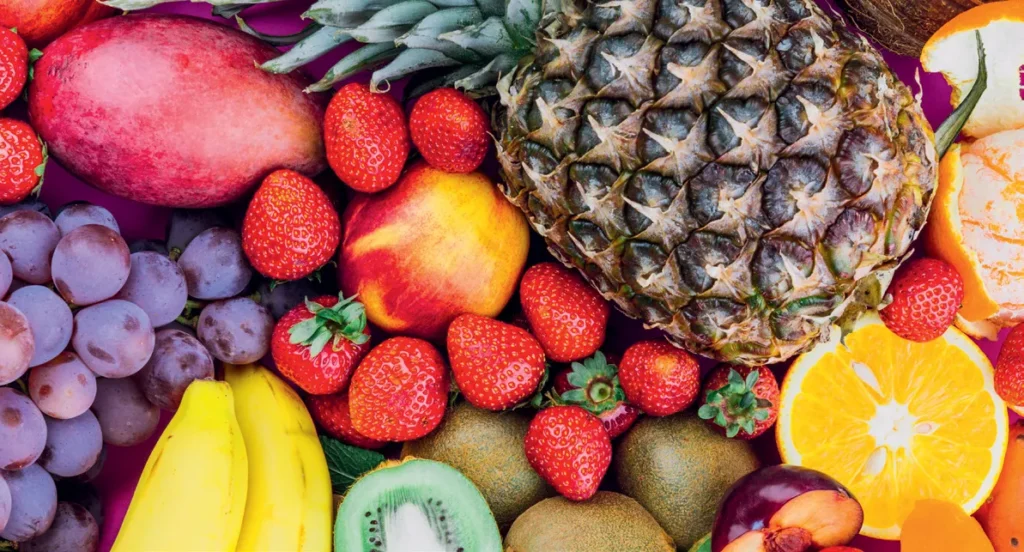
Get more out of your summer fruit

Get more out of your summer fruit

Words: Gabrielle Newman, ‘The Fast 800’ programme Nutritionist

With the current cost of living and the price of healthy food on the rise, we know how frustrating it can be to throw away forgotten foods from the back of the fridge.

Not only is it costing you money, the environmental impact is huge with annual food wastage totalling approximately 1.3 billion tonnes (that’s one trillion three hundred billion kilos!). Almost half of the fruit and vegetables produced worldwide fall within this number.

Understanding how to preserve the freshness of your fruit and veg can save you time, money and be more nutritious. As a Nutritionist for The Fast 800 programme, here are my top tips to extend the life of fresh produce and minimise food waste.

1. Separate high-ethylene producing fruit

Ethylene is a natural gas produced by fruit and can accelerate the ripening process of ethylene-sensitive fruit and vegetables. To prevent this from happening, keep fruit that is high in ethylene gas like apples and bananas separate from your other fruit and veg (unless you’re trying to speed up the ripening of your avocados).

2. Invest in storage containers with airtight seals

Investing in quality storage containers will slow down the oxidation process and preserve nutritional content. Airtight containers create a protective barrier that helps maintain the purity of the produce – glass is ideal, but any container will do. This simple switch can make a significant difference in extending the shelf life of your fresh fruits and vegetables.

3. Tailor the temperature of your storage

Different types of fruits and vegetables thrive in varying temperature conditions, so by tailoring the temperature of your storage you can significantly prolong freshness. For example, tomatoes are best stored at room temperature, while leafy greens prefer cooler environments.

4. Shop smarter

Smart shopping is a key component; reducing food waste while maximising nutrient variety. By incorporating smart shopping practices and meal planning, you not only enjoy the benefits of fresh produce and cooking, you will minimise unnecessary waste.

5. Befriend the freezer

Frozen vegetables can be just as nutritious as fresh, as they are snapped frozen when harvested. They can also be far more cost- effective as they’re often cheaper and have a longer shelf life once purchased. Incorporate frozen produce into smoothies, stir-fries, and soups for a quick and nutritious addition to your daily meals.

6. Try Top-to-Tail cooking

Embrace “top-to-tail” cooking for fruits and vegetables by using the entire plant, including stems, leaves, and peels, in your recipes. This is not only good for the planet, but also enhances the nutritional profile of your meals. An easy switch is to stop peeling your veg, just give them a thorough wash.


More from

Health and Wellness

What Medicare Actually Covers in 2026 (and Where the Gaps Are)
Health and Wellness

What Medicare Actually Covers in 2026 (and Where the Gaps Are)

Medicare is one of those systems Australians trust without quite understanding. We carry the green card for decades, tap it at reception desks and pharmacy counters, and mostly find out what it does and doesn’t cover at the exact moment it matters: when the receptionist mentions a gap fee, or the chemist rings up a script at ten times the price you expected. The system covers a great deal. But the edges are fuzzy, and the edges are where the surprise bills live. The good news is that 2026 has brought some genuine improvements, including the cheapest general PBS scripts in more than two decades. The less good news is that the gaps, particularly dental and optical, are as wide as ever. Here is what the card actually buys you this year, what it doesn’t, and the handful of checks that can save a household hundreds of dollars. The GP visit: why some people pay nothing and you pay $40 Medicare pays a set rebate for a standard GP consultation. What you pay depends entirely on how the practice bills. A bulk-billing clinic accepts the rebate as full payment, so you walk out without opening your wallet. A private-billing clinic charges its own fee, you claim the rebate back, and the difference is your gap. That gap is set by the practice, not by Medicare, which is why two clinics in the same suburb can charge wildly different amounts for the same ten minutes. Many practices bulk bill children and concession card holders but charge everyone else, and plenty have quietly moved from bulk billing to mixed billing in recent years. None of this is secret; it is just rarely volunteered. Ask how you will be billed when you book, and if the answer stings, the Healthdirect service finder makes it easy to compare clinics near you. Changing your regular GP is a bigger decision than chasing a free appointment, but for routine scripts and referrals, knowing a bulk-billing option exists nearby is useful leverage. Scripts: the PBS just got noticeably cheaper When a medicine is listed on the Pharmaceutical Benefits Scheme, the government pays most of the cost and you pay a capped co-payment. From 1 January 2026, that cap dropped to $25 for general patients, down from $31.60 the year before, and the biggest cut to the general co-payment in over twenty years. Concession card holders pay $7.70 a script, a rate that has been frozen since 2024 and is legislated to stay frozen through 2029. Then there is the PBS Safety Net, which far fewer people use than should. Once your household’s spending on PBS scripts passes $1,748.20 in a calendar year ($277.20 for concession card holders), scripts cost just $7.70 for the rest of the year, and nothing at all for concession holders. The catch is that someone has to be counting. Ask your pharmacist to keep a Safety Net record for your family; they can track the tally and tell you when you qualify. If your household juggles several regular medicines, this one habit can be worth hundreds of dollars in the back half of the year. Current rates are always listed on the PBS website. The big three gaps: teeth, eyes and everything physio Now for the part that catches almost every household. For adults, Medicare generally does not cover dental check-ups or treatment, glasses or contact lenses, or routine physiotherapy, podiatry and similar therapies. These are not small omissions; for many families they are the largest health costs of the year, and they sit almost entirely outside the system. There are two partial exceptions worth knowing. Children aged 0 to 17 in families receiving certain payments, including Family Tax Benefit Part A, may be eligible for the Child Dental Benefits Schedule, which covers up to $1,158 of basic dental work per child over two calendar years. Eligibility is assessed automatically, but plenty of eligible families simply never use it; you can check yours through Services Australia. Public dental services also exist for concession card holders, though waiting lists in most states are measured in months or years, not weeks. These gaps are the main reason people hold private health extras cover, and extras deserve a cold-eyed annual review. Before renewing, add up what you actually claimed on dental, optical and physio last year and hold it against the premium. If you claimed less than you paid, you are not insuring, you are donating. If you claimed more, keep it and check your limits. It is a ten-minute exercise that regularly changes minds in both directions. Mental health: more cover than most people realise If you are struggling, start with your GP. A Mental Health Treatment Plan unlocks Medicare rebates for up to 10 individual psychology sessions each calendar year, plus up to 10 group sessions. The rebate rarely covers the full fee, so ask two questions when booking: what is the gap per session, and does the practitioner bulk bill plan sessions for any patients? Some do, particularly for concession card holders, and your GP often knows who. Telehealth sessions attract the same rebates, which has quietly transformed access for women in regional areas and for anyone whose week does not accommodate a 3pm appointment across town. If cost is the barrier, Healthdirect’s guide to low-cost mental health services lists the free and subsidised options worth trying first. Newer treatments: where the out-of-pocket question matters most The most expensive surprises in Australian healthcare tend to involve newer prescription treatments. There is often a long delay between a medicine being approved by the TGA and it being subsidised on the PBS, and some medicines never make the list at all. In that window, you pay the private price, which can run to hundreds of dollars a month, with none of it counting toward the PBS Safety Net. Weight loss medication is the clearest current example. It is among the most asked-about prescriptions in the country, and the coverage rules confuse almost everyone, because

Why friendship breakups can hurt more than romantic ones
Health and Wellness

Why friendship breakups can hurt more than romantic ones

“A friend is someone who knows all of you and still loves you.” – Elbert Hubbard And that is exactly why it hurts so deeply when a friendship falls apart. Unlike romance, there is often an unspoken belief that friendship will be a constant in an unpredictable world. Friends become our safe place, our chosen family, the people we imagine will be beside us for the long haul. Whether it is a lifelong companion from childhood or a newer connection formed later in life, close friends know our backstory and our vulnerabilities. They see us at our most unfiltered, through life’s highs and lows, and accept us just as we are. That kind of connection feels rare and deeply comforting. Think about the warmth that comes from sharing dreams, secrets and stories over coffee or a glass of wine. Those moments are not just emotionally nourishing, they also trigger powerful chemical reactions in the body. Laughter and connection release dopamine and endorphins, trust encourages oxytocin, and the feeling of being valued strengthens serotonin. Friendship does more than lift our mood, it helps calm our nervous system and brings a sense of ease. When life becomes heavy, friends often show up in meaningful ways. They organise meals, check in without being asked, help with the kids or simply sit beside us when words feel hard to find. Over time, a quiet reliability forms. Because the connection feels so nourishing, we may overlook small frustrations and remind ourselves that no friendship is perfect. We soften, adjust and make space for one another, creating a protective bubble in an otherwise busy world. In neuroscience, this sense of safety is called belonging. Our brains are wired for it. In early human history, belonging to a group meant survival. We shared resources, protected one another and stayed alert to danger together. That wiring still exists today. When we feel we belong, our nervous system settles into a state of safety. So when a friendship breaks down, the grief can feel surprisingly intense. The person we relied on is suddenly absent, and the loss can trigger deep feelings of rejection. It may feel disorienting, like losing a steady anchor we never imagined would disappear. Romantic relationships can be exhilarating, full of excitement and possibility. Yet many of us understand, somewhere deep down, that romance carries risk. Hearts can break and relationships can end, and it is often our friends who help us through those moments. When a trusted friendship ends, it can feel as though a piece of our emotional foundation has shifted. The pain is not only about losing the person, but also about losing the sense of belonging that existed within the friendship. It is not necessarily a failure, but sometimes a reminder that certain relationships are only meant for a season. To help navigate the loss of a friendship, therapist Justine Williams suggests a gentle three-step approach: see, feel and hear. First, see the friendship clearly. Try to view it with perspective, noticing it as it truly was rather than through an idealised lens. Focus your energy on the people who genuinely lift you up and value you. Next, feel your grief rather than pushing it away. Allow sadness to move through you and practise compassion towards yourself. Accept what you cannot control, and if you feel stuck, seeking professional support can help untangle lingering guilt or self-doubt. Finally, hear your inner wisdom. Ask yourself what advice you would offer a child, sibling or close friend in the same situation. Trust that guidance and allow yourself the time and space needed to heal. Friendship breakups can be deeply painful, but they can also invite reflection, growth and a renewed understanding of what connection truly means. About the author Justine Williams Founder of The Feel Good Studio and Hyp Little Fairy Tales® Affectionately known as The Fairy Godmother for her work supporting children, parents and families. A highly regarded Clinical Hypnotherapist, speaker and multi-award-winning author. Website Email

You are not irreplacable, you are resilient!
Health and Wellness

You are not irreplacable, you are resilient!

You have two kidneys. You only need one. Long before anyone coined a phrase for it, your body quietly modelled the principle we now call resilience at work — packed with spares, one organ at a time, built not to be precious but to last. Evolution looked at the long odds of staying alive and decided that redundancy, a quiet backup sitting ready and unbothered, was the kindest thing it could give you. The Myth of the Irreplaceable Person Your ego disagrees. It has its own theory, and it recites it at 2am: that you’re the one who truly understands the client, the unrepeatable knot of skill the whole thing depends on. It’s a comforting story. The body has spent years gently disagreeing. We’ve always believed this at scale. Every monarchy that claimed divine right discovered, eventually, that divinity has a short attention span. When Steve Jobs died in 2011, the consensus was that Apple had lost the one mind it could never replace; under Tim Cook it went on to become the most valuable company in the world. [SUGGESTED LINK: Tim Cook’s leadership and Apple’s growth post-Jobs] The gap between valuable and irreplaceable is the gap between a fact and a fairy tale. Work culture prefers the fairy tale. It calls you a “key person” and means it as a compliment — when underneath sits a system that falls over the moment one human leaves. Engineering has a blunter name for that. It isn’t talent; it’s a single point of failure. A design flaw. [SUGGESTED LINK: single point of failure in organisational design] What Strong Systems Actually Look Like The body knows better, because it has no ego to defend. Two lungs, two kidneys, two brain hemispheres that cover for each other. A liver that grows back. An immune system that reroutes when a defence is breached. None of this is sentiment. Evolution doesn’t build irreplaceable parts; it builds systems that outlive the failure of any one of them. You are not the jewel in the crown of natural selection. You are a distributed backup system wrapped in skin and anxiety — and that, it turns out, is the good news. Here’s the part we flinch from, so I’ll just say it. Most of what you do — the emails, the meetings, the decisions — someone competent could learn in a few months. Not the intuition, the relationships, the context you carry in your bones. But the function? That’s a transferable skill wearing your name badge. AI didn’t make this true; it only made it loud. The printing press didn’t make the monk less skilled, only less necessary. We spend our lives confusing the two: defending how necessary we are, and missing what we’re for. [SUGGESTED LINK: AI and the future of work] Redundancy as a Design Principle, Not an Insult So before you spiral and refresh your LinkedIn, turn it over. Redundancy was never the insult you took it for. It’s the whole principle of resilience — why planes stay aloft, why your heart keeps beating when one pathway misfires. Strong systems aren’t the ones with an indispensable part; they’re the ones where no part is. When only one person understands the billing system, that isn’t a measure of their importance. It’s a hostage situation. Don’t be the load-bearing wall whose removal brings down the ceiling. Be part of the frame — holding things up precisely because it no longer all rests on you. And here’s the gift hidden in all of it: once you stop defending how hard you are to replace, you start to notice what genuinely can’t be. It was never the spreadsheet or the code. It’s the way you make a colleague feel human again after a brutal quarter; the meaning you pull out of chaos. None of it fits on a CV, because none of it is a component. It’s the connective tissue — not the parts, but what happens between them. What Genuinely Cannot Be Replaced “But doesn’t that mean we’re all worthless?” is the wrong question. It mistakes one axis for another. Any musician in the orchestra can be swapped and the note still sounds — but the ensemble, these people on this particular night, will never happen twice. You’re replaceable as a function and unrepeatable as a presence. You matter not because no one else could do your job, but because you’re the one doing it now, bringing the strange, specific thing only you bring. That’s not nothing. It’s just not what we were taught to call worth. We need this now, in an age of industrial-scale redundancy anxiety. AI writes the emails; an algorithm makes the trades, with no meltdowns and no lunch break. You are more functionally redundant than any generation before you — and the answer isn’t to deny it. It’s to stop hanging your whole identity on the function in the first place. You have two kidneys. You only need one. And you’ve spent your whole life not thinking about the spare — not resenting it, not feeling diminished by it, not lying awake afraid of it. You just lived, while the backup sat there quietly keeping you alive. Maybe it’s time to extend that same grace to the rest of you. The spare was never an accusation that you weren’t enough. It was the most honest kindness your body could manage: a margin, a second chance, the reason the whole fragile system keeps going. You are not irreplaceable. You are something better. You are resilient — and you were built that way on purpose. About the author Andrew Harmer Co-Founder & Software Architect, Get It Media Magazine Operations Software Engineering Andrew is co-founder of Get It Media, where he builds the software behind modern publishing — practical tools for creating, managing and distributing web content. He also writes for Get It Magazine on men's health and lifestyle. Website Email

Your skincare routine might be outdated
Health and Wellness

Your skincare routine might be outdated

A new beauty ritual is quietly making its way into daily routines, and it has little to do with serums or sheet masks. From collagen powders and gut-friendly elixirs to fasted olive oil and lemon water, “ingestible beauty” is becoming one of the biggest shifts in the wellness space as more consumers focus on beauty from the inside out. The trend reflects a broader move away from quick topical fixes and toward daily rituals designed to support skin, hair and overall wellbeing at a deeper level. For years, skincare has centred on what we apply externally. But as research around the gut-skin connection continues to grow, experts are increasingly questioning whether topical products alone are enough. “Wellness expert and Head of New Product Development at Phytologic, John Mitrev, says true skin health starts internally. “Although topical skincare does help, true beauty starts from within,” he says. “To look its radiant best, healthy, glowing skin requires that we consume crucial nutritional ingredients that support skin health from the inside out, each and every day.” The growing focus on ingestible beauty has sparked interest in ingredients designed to support visible beauty outcomes through nutrition and gut health. Marine collagen is used to help maintain the skin’s structure and elasticity, while hyaluronic acid supports hydration. Vitamins C and E provide antioxidant protection, and probiotics and postbiotics are increasingly being recognised for their ability to support both gut health and skin health. “Antioxidants protect skin from free radical damage and the resulting inflammation, often triggered by UV light,” Mitrev explains. “Collagen supports the internal structure of the skin, maintaining firmness and decreasing the appearance of wrinkles. Probiotics, meanwhile, can balance the skin’s microbiome, which impacts inflammation.” This “gut-first” approach is also driving the rise of brands such as bellyME, which focus on supporting the microbiome with targeted probiotics and postbiotics as part of a broader beauty and wellness routine. By combining gut support with ingredients like collagen, hyaluronic acid and antioxidant-rich botanicals, the aim is to support healthier skin from within, rather than relying solely on topical products. The shift also reflects changing attitudes around beauty more broadly. Increasingly, consumers are looking for routines that feel holistic, sustainable and connected to overall wellbeing, rather than chasing quick fixes or overly complicated skincare regimens. That doesn’t mean traditional skincare is disappearing any time soon. Cleansers, moisturisers and SPF still play an important role in maintaining healthy skin. But experts say the future of beauty is likely to involve a combination of internal and external care working together. The takeaway? Your skincare routine might not be wrong – it could just be incomplete.