Health and Wellness

The hidden risk: understanding breast density and cancer

The hidden risk: understanding breast density and cancer

YOUR GUIDE TO UNDERSTANDING BREAST CANCER RISK AND SCREENING OPTIONS

By Dr Susan Hawes

How common is breast cancer?
Over 21,000 Australians will be diagnosed with breast cancer this year. Risk of breast cancer
increases greatly after the age of 50. However, around 1,000 women aged under 40 are diagnosed with
breast cancer each year. 1:7 women and 1:550 men are diagnosed with breast cancer in their
lifetime.

I have felt a breast lump. Are most breast lumps cancerous?
No. Approximately 10% of breast lumps are cancers, and 90% are not cancer. It is important to have
any new breast changes investigated with your doctor. This can include a new lump, dimpling of the
skin, new onset redness, nipple changes such as crusting, ulceration, abnormal nipple discharge or
new onset of nipple inversion.

Should I be checked out if I had a normal screening mammogram last year?
Yes. If a patient develops new breast symptoms these should be checked with a doctor. BreastScreen
is a health initiative that aims to reduce illness and death from breast cancer. Women aged 50-74 are
actively invited to free mammogram screening every 2 years. Women aged 40 to 49 or over 75 can also
attend who do not have breast symptoms. Some women can also undergo breast checks and have breast
imaging organised with their general practitioner.

Can women with breast implants have mammograms?
Yes. It is generally safe to have a mammogram with breast implants. However, it is important to
advise the imaging company or BreastScreen beforehand so that the best images can be obtained.

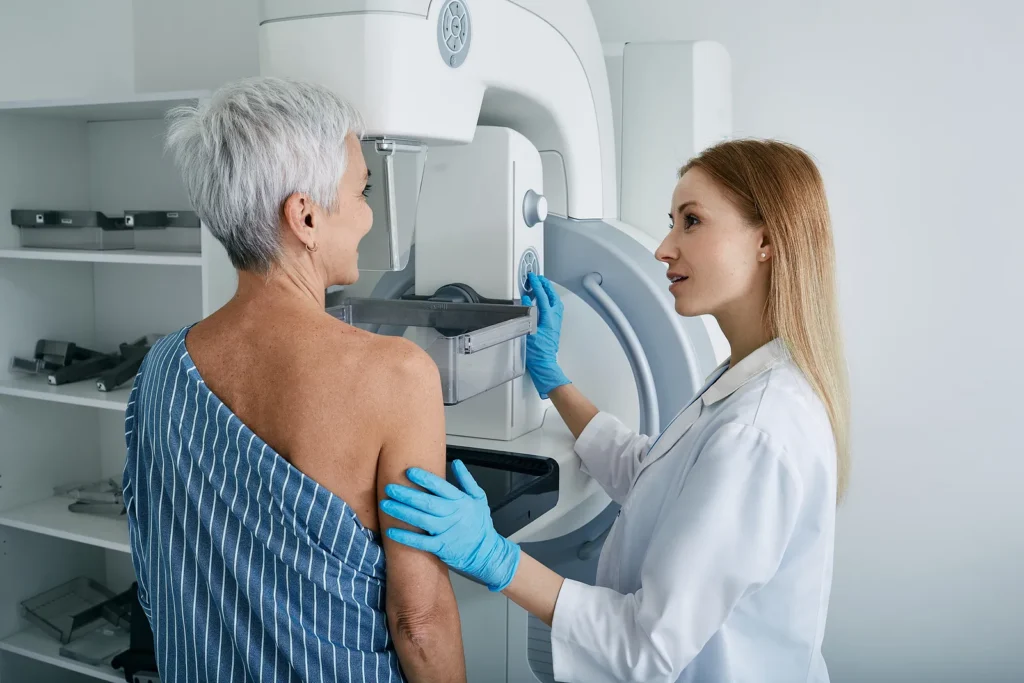
What is breast density?
Breasts are made of a mixture of glandular tissue, fibrous connective tissue, and fatty breast
tissue. It is not something that can be determined when breasts are examined.
Only a radiologist looking at a mammogram can tell if a woman has dense breasts. Density describes
the relative amount of these different types of breast tissue as seen on a mammogram. Dense breast
tissue has relatively higher amounts of glandular and fibrous connective tissue and relatively low
amounts of fatty breast tissue. Dense breast tissue can make mammograms more difficult to interpret
because dense breast tissue and abnormal changes both appear white on mammograms whereas fatty
tissue appears dark. This can result in women with dense breasts being called back for more
follow-up testing to reduce risk of missing cancer. At present there is not enough evidence
to recommend more testing in women with dense breasts; however, breast MRI, USS and contrast
mammograms are tests that can give doctors more information to reduce the risk of missing cancer.
You can discuss this with your GP or be referred to a breast specialist to discuss this further.

Are dense breasts common?
Yes, dense breasts are common. Nearly half of all women who are 40 and older who get mammograms are
found to have dense breast tissue. Higher breast density can be
hereditary, is associated with low body mass index and may be seen in women who use hormone
replacement therapy for menopause symptoms. Lower breast density can be due to increasing age and
having had children.

What is a strong family history?
Having 2 or more people in the family – particularly first- degree relatives (mother, sister or
daughter) who meet any of the following criteria is classified as strong:
• Breast cancer before age 40
• Triple negative breast cancer
• First degree relatives with breast or ovarian cancer
• Breast or ovarian cancer in the same woman
• Male breast cancer
• Breast cancer that occurs in both breasts
• Ashkenazi Jewish history
• Many people on the same side of the family affected
by breast, ovarian, pancreatic, prostate cancer, sarcoma or melanoma.

95% of breast cancers have nothing to do with family history.
What tests will be performed if my doctor is suspicious of breast cancer?
After thorough history and clinical examination your doctor may order the following. Breast imaging
such as mammogram and ultrasound and in some instances breast MRI. Diagnosis also requires taking
some tissue with a biopsy which is usually performed by a radiologist and involves a fine needle
biopsy or core biopsy. If you are diagnosed with breast cancer then you will be referred to a
surgeon to discuss further treatment options.

What if I have breast cancer?
Many people diagnosed with breast cancer are successfully treated. Finding breast cancer early
offers the best chance of successful treatment and recovery. The five-year survival rate for Stage
1 (early) breast cancer is, on average, 100% and Stage 2 is 95%. For locally advanced cancers
(known as Stage 3) the survival rate is 81%, while the five-year survival rate for Stage 4
(metastatic breast cancer) is significantly lower at 32%.

Further information.
Having a breast problem can be very stressful, particularly if you need lots of tests. Some women
who receive the all-clear with their results may find it takes time to stop worrying. The best contact is
initially your general practitioner to speak to about any breast concerns you have and they can refer you to a breast
specialist if required.

Talking with your partner, family or friends can be helpful, or you can call the Cancer Council
Helpline on 13 11 20.
About Dr Susan Hawes:
Dr Susan Hawes from Gold Coast Breast Surgery is a local gold coast surgeon specialising in the
treatment of breast conditions such as breast cancer surgery, screening and benign breast
conditions.

She is also an experienced general surgeon who cares for patients with general surgical
conditions-including gallbladder problems and hernias.

Dr Hawes grew up on the Gold Coast and completed her medical training at Griffith University. She
was accepted into general surgery training and has gained experience from her training all over
Queensland. She completed further specialist training in breast cancer surgery and reconstruction
in Canberra and Chris O’Brien Life House Hospital in Sydney.

She is a mother of two young children and is compassionate and understands the needs of patients
diagnosed with breast cancer.

For more information on Dr Susan Hawes visit:
Dr Susan Hawes
B.Pharm MBBS FRACS
Suite 1, Ground Floor
Gold Coast Private Hospital 14 Hill Street
Southport Qld 4215
P 07 5605 9888
goldcoastbreastsurgery.com.au
[email protected]

More from

Health and Wellness

A 2026 Guide to Weight Management Care for Australian Women
Health and Wellness

A 2026 Guide to Weight Management Care for Australian Women

Weight management is one of the most discussed topics in Australian women’s health, and one of the most misunderstood. It sits at the intersection of physiology, psychology, life stage, social messaging, and an increasingly complex healthcare system. For women navigating midlife, post-pregnancy, perimenopause, or chronic health conditions, the topic can feel both deeply personal and frustratingly impersonal at the same time. This guide is not a treatment recommendation. It is an overview of how weight management care is structured in Australia in 2026: what the major categories of support look like, how prescription medicines and pharmacies are regulated, what telehealth involves, and what questions are useful to bring into a GP appointment. Any decision about treatment should be made in consultation with a qualified Australian healthcare professional who knows your full medical history. Why weight changes across a woman’s life Weight isn’t static, and the factors that influence it shift across the decades. Through the twenties, energy balance is often the most visible factor. Through the thirties, pregnancy, postpartum recovery, and lactation each affect body composition, sometimes in ways that don’t simply reverse with time or effort. By the early forties, perimenopause begins for many Australian women. Levels of oestrogen and progesterone start to fluctuate. Sleep quality often decreases. Cortisol patterns can change. Muscle mass tends to decline gradually, which affects resting metabolic rate. Cardiovascular risk markers, including blood pressure and lipid profiles, can shift. By the time menopause is reached, typically in the early fifties, the hormonal environment is substantially different from what it was at 35. These changes do not happen to every woman, and they don’t follow a single timeline. But they do mean that the strategies that produced results at 28 may not produce the same results at 48, even when effort is identical. Understanding this physiological context is a useful first step toward making informed care decisions. Categories of weight management support in Australia Australian healthcare offers a range of approaches to weight management, often used in combination rather than isolation. Lifestyle and behavioural support. Accredited Practising Dietitians, exercise physiologists, and accredited counsellors offer structured programs around nutrition, physical activity, sleep, and stress management. These remain the foundation of most clinical guidelines and are often the first line of care recommended by a GP. Psychological support. Disordered eating patterns, emotional eating, and the psychological dimensions of weight are often addressed by registered psychologists. Medicare-supported sessions are available with a GP referral under a Mental Health Care Plan. Medical treatment. In some cases, a GP or specialist may discuss medical treatment options after assessing health history, current medications, comorbidities, and weight-related health risks. Medical treatments for chronic weight management in Australia are prescription-only (Schedule 4) medicines, which means they require a prescription from an authorised prescriber and are not available over the counter. Discussion of specific medicines, dosing, and suitability is between an individual and their treating clinician. Surgical treatment. Bariatric surgery is performed in Australia for adults meeting specific clinical criteria. It involves significant pre-assessment, multidisciplinary care, and long-term follow-up. It is typically considered for people with severe obesity and weight-related health complications, and the decision to proceed is made by a specialist surgical team in consultation with the patient and their GP. Each of these categories has a place in Australian guidelines. None is universally right, and most clinicians take a stepped or combined approach based on the individual’s circumstances. How the regulatory system works Three regulators shape the weight management care landscape in Australia. The Therapeutic Goods Administration (TGA). The TGA is the arm of the Department of Health and Aged Care responsible for evaluating and approving medicines and medical devices for use in Australia. Before a prescription medicine can be supplied here, it must go through the TGA’s evaluation process. The TGA also maintains the Australian Register of Therapeutic Goods (ARTG), the public list of every approved product. Australian law prohibits the advertising of prescription-only medicines directly to the public, which is why you will rarely see specific medicine brands named in editorial or consumer-facing content. The Australian Health Practitioner Regulation Agency (AHPRA). AHPRA works with 15 National Boards (including the Medical Board, the Pharmacy Board, and the Nursing and Midwifery Board) to register and regulate healthcare practitioners. Anyone working in Australia as a doctor, pharmacist, nurse, or other regulated health professional should be searchable on the public AHPRA register by name and registration number. Pharmacy and pharmacist oversight. Pharmacies in Australia are licensed under state or territory law and operate within the Pharmacy Board of Australia’s professional standards. Any Schedule 4 medicine dispensed by an Australian pharmacy must be supplied against a valid prescription from an authorised prescriber, and a registered pharmacist must review the prescription before dispensing it. Together, these three regulatory layers are what makes a particular provider “regulated” in the Australian sense. The presence or absence of these checks is the most important practical difference between a legitimate Australian provider and a less formal channel. Telehealth and online pharmacy in 2026 Telehealth has expanded significantly in Australian primary care since 2020 and is now a routine part of how many patients access GP and specialist consults. In the context of weight management, telehealth typically involves a video or phone consult with an AHPRA-registered prescriber who reviews health history, current health status, and treatment suitability before any decision is made. Online pharmacies in Australia function the same way as community pharmacies, with the dispensing and delivery happening at a distance. A regulated Australian online pharmacy is licensed under state or territory law, employs registered pharmacists who review each prescription, and dispenses medicines listed on the ARTG. Burst Health Pharmacy is one example of an Australian online pharmacy operating within that regulatory framework, offering weight-loss support services that combine a telehealth consult with an authorised prescriber and pharmacist-reviewed dispensing. Other similar services exist. It is worth understanding the distinction between a regulated Australian online pharmacy and an overseas-sourced or informal supply route. Medicines sourced through social media pages, messaging

Young Men, Influencers, and the Shaping of Masculinity
Health and Wellness

Young Men, Influencers, and the Shaping of Masculinity

Words: Andrew Harmer In an era defined by social media, the influence of online personalities on young minds has never been more profound – particularly when it comes to ideas about masculinity. A recent survey by the Movember Institute has revealed a striking statistic: 68% of young Australian men actively engage with “masculinity influencers” across platforms like Instagram, TikTok, YouTube, and emerging social apps. These influencers range from fitness gurus and lifestyle coaches to motivational speakers and self-styled “alpha male” advocates. Their content often revolves around personal development, financial success, physical fitness, dating advice, and what it means to “be a real man” in today’s society. While this has created opportunities for positive role modelling and self-improvement, health experts are sounding the alarm about the potential risks these messages may carry for young men’s mental health and identity formation. At the heart of the concern is the way masculinity is being defined – or more accurately, narrowed. Many influencers present a version of manhood that prioritizes dominance, stoicism, physical prowess, and material success, often discouraging emotional vulnerability or non-traditional expressions of masculinity. According to psychologists, when young men are repeatedly exposed to rigid or hyper-masculine ideals, it can create internal conflicts. Boys who do not or cannot align with these portrayals may feel inadequate, ashamed, or isolated. Mental health professionals warn that such influences can contribute to anxiety, depression, body dysmorphia, and even exacerbate feelings of loneliness. This is particularly concerning given that suicide remains the leading cause of death for Australian men aged 15–44, and social isolation is one of the most significant contributing factors. By promoting an unattainable or narrow version of manhood, influencers may – knowingly or unknowingly – deepen the struggles that young men already face. However, it’s important not to paint all masculinity influencers with the same brush. There are many who advocate for healthy masculinity – encouraging emotional intelligence, open communication, mental health support, and community building. Programs like Movember’s “Man of More Words” campaign highlight the need for men to talk openly about their feelings, and some influencers are positively reinforcing these messages. The conversation around masculinity is at a crossroads. Young men are seeking identity, purpose, and belonging in a fast-changing world, and online voices play a growing role in filling that void. The challenge, experts say, is ensuring that this influence is positive rather than damaging. Educational campaigns, mentorship programs, and open dialogues are being called for to help young men critically assess the messages they consume online. Initiatives in schools and community groups across Australia, including the Gold Coast, are also stepping in to create spaces where young men can discuss masculinity in broader, healthier terms – promoting self-worth that isn’t tied to outdated stereotypes. As we move further into 2025, the opportunity lies in balancing the empowerment that influencers can offer with the support and education young men need to thrive mentally, emotionally, and socially. About the author Andrew Harmer Co-Founder & Software Architect, Get It Media Magazine Operations Software Engineering Andrew is co-founder of Get It Media, where he builds the software behind modern publishing — practical tools for creating, managing and distributing web content. He also writes for Get It Magazine on men's health and lifestyle. Website Email

What You Need to Know About Skin Cancer
Health and Wellness

What You Need to Know About Skin Cancer

What You Need to Know About Skin Cancer Why regular skin checks should be part of your health care Australia has one of the highest rates of skin cancer in the world. More than two in three of us will be diagnosed with some form of it in our lifetime – a statistic that makes understanding this disease not just useful, but essential. The primary culprit? Ultraviolet (UV) radiation from the sun. While we all love our outdoor lifestyle, that exposure adds up over the years, especially for those with fair or freckled skin, a family history of skin cancer, or simply the passing of time. The good news is that when caught early, most skin cancers are highly treatable. So, what exactly should you be looking out for? There are three main types of skin cancer, and each behaves differently. Basal cell carcinoma (BCC) is the most common, accounting for roughly two-thirds of all cases. It develops in the top layer of skin and, while it can cause local damage, it rarely spreads to other parts of the body. You might notice it as a pearly bump, a flat flesh-coloured or pinkish patch, or a sore that heals and then returns. Squamous cell carcinoma (SCC) makes up about one in three skin cancers and tends to appear on sun-exposed areas like the face, ears, hands, and arms. It often looks like a firm red bump, a scaly patch, or a sore that doesn’t heal. Left untreated, SCC can spread, which is why early detection matters. Then there’s melanoma – the one that rightly gets the most attention. Although it accounts for only around one per cent of skin cancers, melanoma is the most dangerous because it’s more likely to spread to other parts of the body. It often appears as a new or changing mole, so any spot that’s asymmetrical, has uneven borders, varies in colour, or is growing in size should be checked without delay. There are also rarer types, including Merkel cell carcinoma, angiosarcoma, and dermatofibrosarcoma, but these are far less common. A useful rule of thumb for checking moles is the ABCDE guide: look for Asymmetry, irregular Borders, uneven Colour, a Diameter larger than six millimetres, and any Evolving changes in size, shape or feel. If anything ticks even one of those boxes, get it checked. When it comes to treatment, options depend on the type and stage of the cancer. Surgery to remove the affected area is the most common approach, but your doctor may also recommend cryotherapy (freezing), topical creams, or radiation therapy. For more advanced cases, immunotherapy and targeted therapy have become increasingly effective. The earlier it’s found, the simpler and more effective treatment tends to be. Prevention remains your strongest line of defence. Wear SPF 50+ sunscreen daily – yes, even on cloudy days – and reapply every two hours when outdoors. Seek shade during peak UV hours (typically between 10am and 3pm), and cover up with broad-brimmed hats, sunglasses, and protective clothing. Most importantly, make regular skin checks part of your routine. Whether that’s a self-check at home every few months or an annual visit to your GP or dermatologist, staying vigilant is the single best thing you can do. Your skin is worth paying attention to. A five-minute check could save your life. ‘Dr Maria Macaspac at Medical @ Australia Fair has a special interest in skin cancer detection and recently diagnosed a squamous cell carcinoma on my leg, which was immediately attended to and resulted in no further surgery.I’m thankful that she picked it up so quickly.’ Leanne Hart DISCLAIMER This article is intended for general informational purposes only and does not constitute medical advice. Always consult a qualified healthcare professional for diagnosis, treatment, and personalised health guidance. If you notice any changes to your skin, see your GP or dermatologist promptly.